|
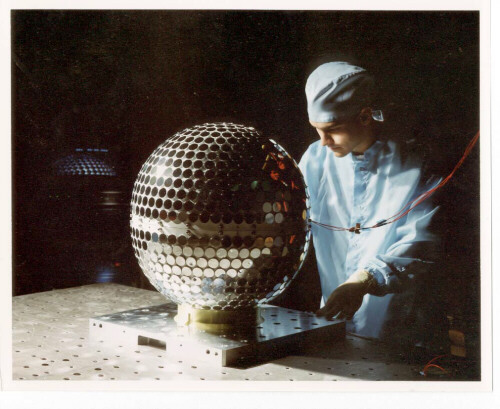
John Vasquez of the Naval Research
Laboratory prepares Starshine 1 for
vibration test. Photo by Michael A. Savell. |
|
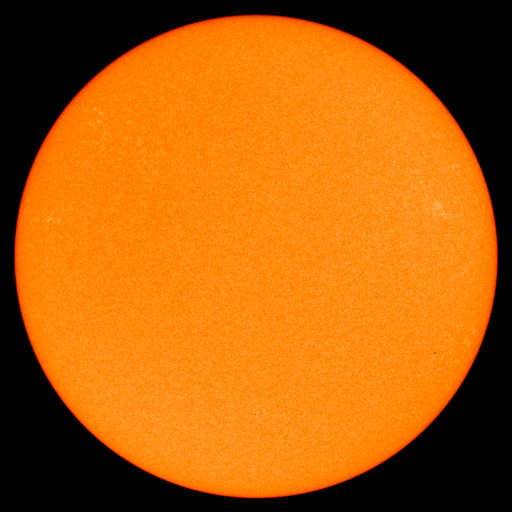
Click Here: Project DescriptionTo See What's Happening on the Sun Right Now, Click here |
|
Connect with Project Starshine on our new Facebook page to learn about Starshine updates and sighting techniques. |
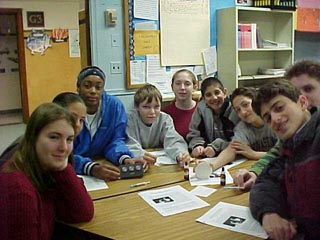 Students from Weber Middle School displaying their mirrors.
|
Weber Middle School
Children in the Young Astronauts/Astronomy Club at Weber Middle School in Port Washington New York proudly display a set of mirrors destined for Starshine 4. "The club members arrived at school at 7:30 AM every day to make sure the project would be completed on time. They worked diligently and followed instructions to the letter" says their science teacher, Cheryl Dodes.
|
| For more reports on student mirror-polishing activities, scroll down to the headings entitled "School and Organization Web Pages Related To Project Starshine" and "Starshine in the News!" |
|
Science Results From Starshine 1
On a scientific note, Dr. Judith Lean of the Naval Research Laboratory presented a paper to the Fall 2001 conference of the American Geophysical Union in San Franciso, CA on how she and her colleagues have used tracking data from our Starshine 1 mission to measure the effects of solar extreme ultraviolet radiation on satellite orbital decay. She also discussed the way in which they will use all the rest of the satellites in the Starshine series to continue to improve their orbital decay prediction codes. Anyone interested in receiving a copy of the slides that accompany her AGU paper should send an email to jlean@ssd5.nrl.navy.mil. |
|
Please direct your questions about any facet of the Starshine program to:
Gil Moore, Director, Project Starshine
(1.2MB RealVideo) - (2.4MB QuickTime)
|
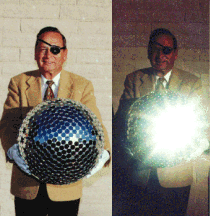 Project Director Gil Moore holding a full-scale mockup of the STARSHINE 1
and 2 satellites. Sunlight is reflected from a single mirror in the image on
the right. Photo by Kerry Kirkland.
Project Director Gil Moore holding a full-scale mockup of the STARSHINE 1
and 2 satellites. Sunlight is reflected from a single mirror in the image on
the right. Photo by Kerry Kirkland.
|
This Page Last Updated: January 16 2018 |